

 Blog
Blog
05 Aug 2026
From 1 May 2026, the Renters’ Rights Act will prohibit landlords and letting agents from asking for, encouraging, or accepting rent offers above the advertised rent. In short, rent bidding wars will be banned across England
While this change removes a visible feature of competitive rental markets, the data suggests it does not remove the underlying pressure that caused bidding in the first place.
Over the past five years, around one in ten new tenancies across the UK have been agreed above the asking rent. That makes rent bidding a meaningful – not marginal – part of how the rental market has been operating.
This matters because the banning of bids does not reduce demand; it simply changes how that demand surfaces.
Looking beyond national averages gives us a clearer picture of where rent bidding has been most prevalent.
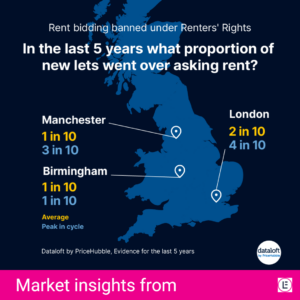
In London, approximately two in ten lets over the past five years have exceeded the advertised rent.
At the peak of the rental cycle, that figure rose to four in ten, highlighting just how competitive the capital’s rental market has been during periods of limited supply.
Manchester shows a similar, though less extreme, pattern.
At the height of the rental cycle, up to three in ten lets were agreed above asking rent – again pointing to strong demand relative to available stock.
Birmingham largely mirrors the UK average, with around one in ten lets exceeding the advertised rent, both on average and at peak points in the cycle.
(Source: Dataloft by PriceHubble – rental market evidence covering the last five years)
By banning rent bidding, the Renters’ Rights Act removes the mechanism through which competition used to be expressed – but not competition itself.
Landlords who previously relied on bidding are likely to respond by:
In practical terms, this means rental pricing is likely to adjust, rather than fall.
The reform curbs a symptom of supply pressure, not its cause. Where demand continues to outstrip supply – particularly in cities like London and Manchester – pricing tension will remain, even if it now appears in a different form.
Understanding this distinction is crucial for both landlords and tenants as the new rules take effect.
 Blog
Blog
 Blog
Blog